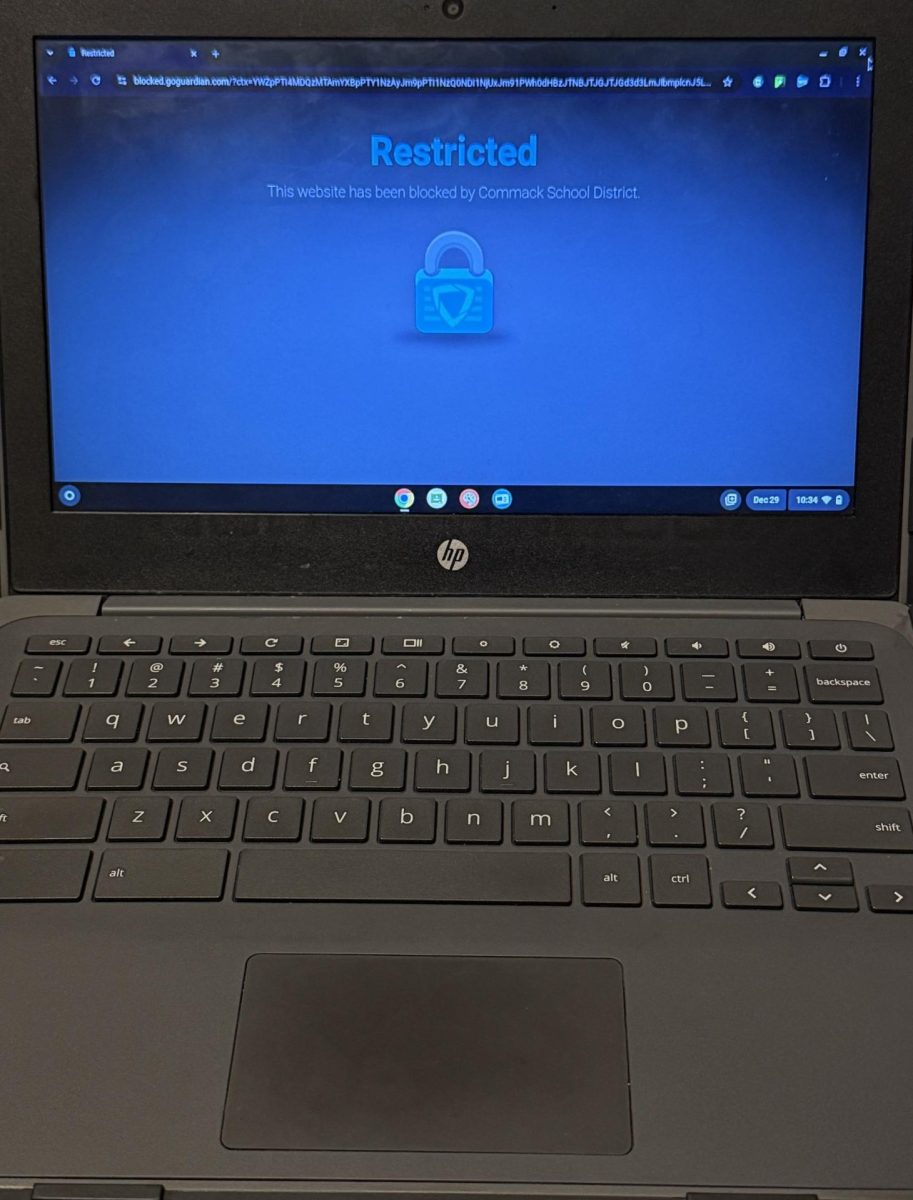

It has been almost one year since the New York State government implemented the cell phone ban across all schools, forcing students to relinquish their cell phones.
The policy prohibits the use and/or possession of any unauthorized devices on school grounds during school hours from the start of homeroom until the end of 9th period.
Students have various opinions on the cell phone ban, including the belief that cell phones can be a distraction, but are also important in emergency situations.
“I have mixed feelings about the cell phone ban. I support it because in my opinion, I think kids are paying attention more and learning more, and also doing more things with their friends. I don’t like it because if there’s an emergency and you need to [contact] your parents, [you can’t,] even though there are school phones,” said freshman Jared B.
Some students believe that the cell phone ban has benefits that lead to higher academic standards, but also believe that during free periods, cell phones should be allowed.
“I know phones could be very distracting […] where you have to focus [in class], it’s where you achieve high academic standards. However, there is a free period during lunch. […] I think you should be able to grant at least four minutes of cell phone usage,” said freshman David H.
Other students disagree with the ban and don’t support it because it is very inconvenient to not have their phones and they feel that after work is completed, they should be allowed to use them.
“No [I don’t support the ban,] because if you lose your phone, it is very inconvenient. [I should be allowed to use it] when I am done with work. I should be allowed to have my phone when I need it,” said freshman Kingston L.
On the other hand, some students completely support the cell phone ban because it helps students be more focused in class.
“I really do support the cell phone ban in the school because it gives students a better chance to stay focused in class, and for them to get higher grades. And it gives less stress for the teachers also. For example, [Megan] Moy in her participation [grades], always has a [section regarding] cell phone use. Now she doesn’t have to do [that] anymore because of the cell phone ban, it gives her less stress,” said freshman Benjamin T.
Other students think that putting cell phones in boxes in each class is a more effective solution rather than requiring students to leave their cell phones in their lockers.
“I would change [the ban] so that students didn’t have to always keep [their phones] in their lockers. I think a better idea would be [….] [having] a little box in each classroom, and then in the beginning of the period, students have to insert their phones into a slot. […] And then at the end of the period, students could take out their phones and then they can go to their next period class,” said freshman Mason L.
Students also suggest another idea where the school should change its policies on the possession of phones.
“I would let kids keep their [phones] in their bags and stay out of their lockers and even in their pockets. [Only] if they constantly have it out and teachers report it, then there should be consequences. I just think, […] if you have a study hall or a free period, then I think you should be allowed to go on your phone,” said Jared.
Students feel that they should be allowed to use their phones during lunch in the cafeteria.
“I would change the cell phone ban, [where] the school should allow students to use all cell phones during [lunch] because it’s […] free time and we can do whatever we want, and I feel like […] for 40 minutes of that time, we should be able to use […] any electronics [from] outside of school,” said Benjamin.
Another student focuses on the logistics of the cell phone ban and how putting phones in a locker is impractical.
“I would keep enforcing these cell phone bans for regular classes. However, for free periods like gym, […] [maybe] we should have [the ability to use our phones]. I feel putting cell phones in the lockers, it doesn’t work out for many people because after school, people have places to go and that takes up too much time,” said David.
Some students feel that the school needs to enforce the rules better with harsher punishments so students are more likely to follow the rules.
“I think the school has the right mindset with the ban, […] but they haven’t enforced it well. Kids are still on their phones. It’s in their backpacks and teachers are not doing much. […] So I feel that maybe the school can impose harder punishments like if you are caught with your phone instead of an immediate warning, it’s an automatic detention or something like that,” said Mason.
Other students feel that the school doesn’t need to enforce the ban as much since teachers enforce it enough.
“There are a few people that don’t really care about the cell phone ban [and] still abuse their cell phone privileges. However, most teachers do what they’re supposed to and enforce the ban, so people don’t use their phones during the school day,” said David.
Some students feel that the school is going in the right direction, but it’s not quite there yet.
Students say that overall the ban has improved the school and increases students’ grades.
“It’s a great idea. I feel […] everyone has the right mindset about it. I just feel they could just enforce it a little bit better and then […] students’ grades will increase,” said Mason.
Students feel that cell phones should be restricted to help kids develop, but it is also important to have some freedom with usage.
“In my opinion, it could be very beneficial if it’s balanced. A little bit of freedom, but no usage during important classes. I think that’s a very good starting point for kids, which can help kids socialize more, learn better, and achieve higher academic standards,” said David.◼️